Oct
2026
Blog Artcile
Ticket sales are landing later. Here's what we're watching.
If your ticket sales have been slow to get going this year, you're in good company. I've had some version of the "sales are so late across the board" conversation with more organisers in 2026 than I could count. Festival teams, touring promoters, venue programmers, events of all shapes and sizes. We're all seeing it.
People are waiting longer to commit. Budgets are tighter, calendars fill up quickly, and plenty of buyers have worked out that most events won't sell out before they get around to it. So they hold off until they're sure.
Late sales are now part of the event landscape, and that's useful context. What it doesn't tell you is whether your own event is on track to sell. That's the question we're spending most of our time on with clients right now, and it's changed how we read the data and how we run campaigns.
What the data is showing us
After every tour we run, we analyse the sales trajectory of each show: how many tickets had sold at each point in the countdown, and how much came in during the final weeks. We compare it against other tours, look for patterns, and use it to build each client's own baseline, so the next campaign is planned around how their audience actually buys.
Across rodeos, touring live shows, and regional and capital city dates, the same shape keeps showing up. Sales build slowly for most of the campaign, then climb sharply at the end. Across one national event series, the typical event sold around 60% of its tickets in the final three weeks and nearly half in the final two. Across a touring show's 13 city dates this year, about a third of sales typically came in the final fortnight, and several dates made more than half their sales in that window. At one regional event, around 2,000 tickets sold in the last two days. Seeing that pattern repeat across such different events is what tells us this goes well beyond one show or one town.

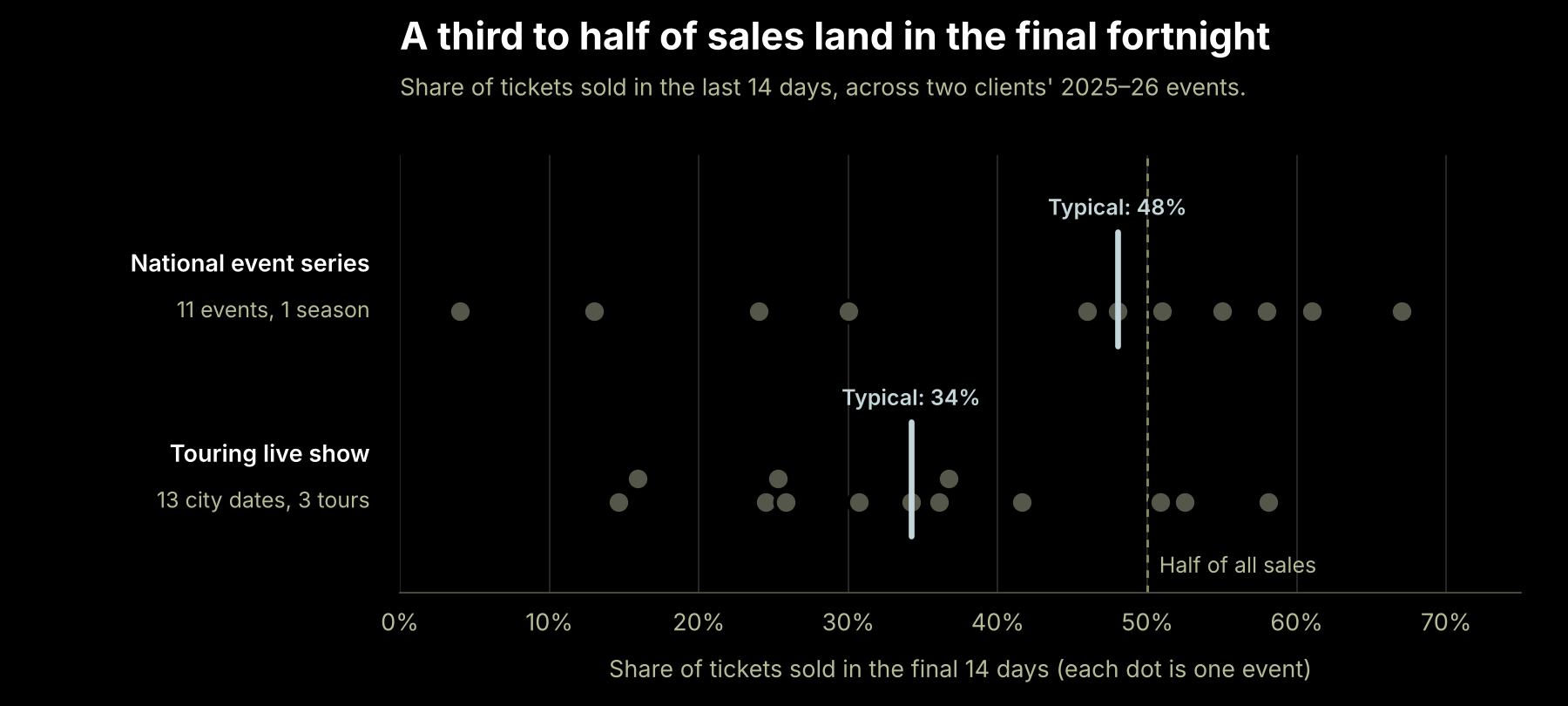
A show we're in the middle of right now. A touring show heading into regional Victoria is following the same trajectory. Nine days out, sales are sitting well behind the other dates on the tour. The last time this show came through it sold early, but that was January. It was a first visit to the town and plenty of people were still on holidays. October is a different story once the end-of-year calendar starts filling up, and this is a town we know buys late.
Knowing all of that doesn't make it less nerve-racking when sales aren't in the bag yet. What keeps us steady is the rest of the data. The ticket page has had over 2,600 views from more than 1,500 people in the last month, for a 500 capacity event, and only around 3% of them have bought so far. That's a lot of people who have looked at the date, checked the price and gone away to think about it.
Look at who is getting ready to buy
When most people buy late, the sales in the early weeks are a small number to be making big decisions from. So we look less at who has bought and more at who is getting ready to.
These are the signals that tell you who has your event pencilled in:
- Ticketing page visits, and how many of those are unique people
- Cost per landing page view on your ads
- Add-to-carts that haven't turned into purchases yet
- Opens and clicks on your event emails
- Saves and shares on your posts, which say more about intent than likes do
We also compare sales against how that event, or that town, has sold before. Comparing a late-buying regional date with a capital city show that sold early will only ever make the regional date look worse than it is.
Does a strong set of signals mean all those people will come back and buy? Not necessarily. What it does tell you is that the interest is there, and that the push can't ease off as the date gets closer.
How we're adapting campaigns
If most of your tickets are going to sell in the final fortnight, the run home needs more from you. Here's what we're changing.
Holding budget back for the end. We now plan most campaigns with spend weighted to the launch and the final weeks, and a lighter middle stretch. For our regional Victorian show, the bulk of the remaining budget is being saved for the final four days. When you've only got a small budget, spending it evenly across the campaign leaves very little for the days that matter most.
Talking to the people who've already shown interest. In the run home, most of the spend goes to people who have visited the ticket page, added to cart or responded to the event without buying. Broad prospecting still runs, but it becomes the smaller share.
Keeping creative in reserve. Fresh creative in the final two weeks makes a real difference. We plan a couple of rabbits to pull out of the hat, like new video, a lineup or program reveal, or a timely angle, so you've got something new to say to fans who have seen your ads for weeks. Reminder messaging such as "this Saturday" and "tomorrow night" also does a lot of the work in the last few days.
Using real scarcity. When one session sells out, say so. For a two-night rodeo in Sydney, promoting the Saturday sell-out drove a strong late surge for the Friday night.
Checking the basics. Make sure tickets stay on sale right up until showtime, and that door sales are set up if you're expecting a late crowd. A late-buying market needs both.
Setting expectations early. We talk through each town's buying history with clients before the campaign starts, so a quiet first month doesn't catch anyone off guard.
Keep pushing through the run home
Late sales make the early weeks of a campaign harder to sit through. The answer is to watch the right numbers and keep enough budget and creative in hand for when your audience is ready to buy.
If you'd like a second set of eyes on where your next event is tracking, get in touch and we'll take a look under the hood.







.jpg)


